US court documents, in plain English.
Why I oughta… Give me a break.
Just tell me what happened,
fer Christ sakes.
Arg!
This website uses A.I. to render important court documents readable to the average human being. Ideally, all the mumbo-jumbo and distractions are removed, and replaced with conversational English. I include the original government docs for you to compare, if you like.
A.I. is an abomination and can make mistakes, but generally it does a pretty good job. In these times of crime, corruption and collusion, a well-condensed court document can be a breath a fresh air, a glimmer of hope in a country gone insane. Read ’em and weep…
I tell you.
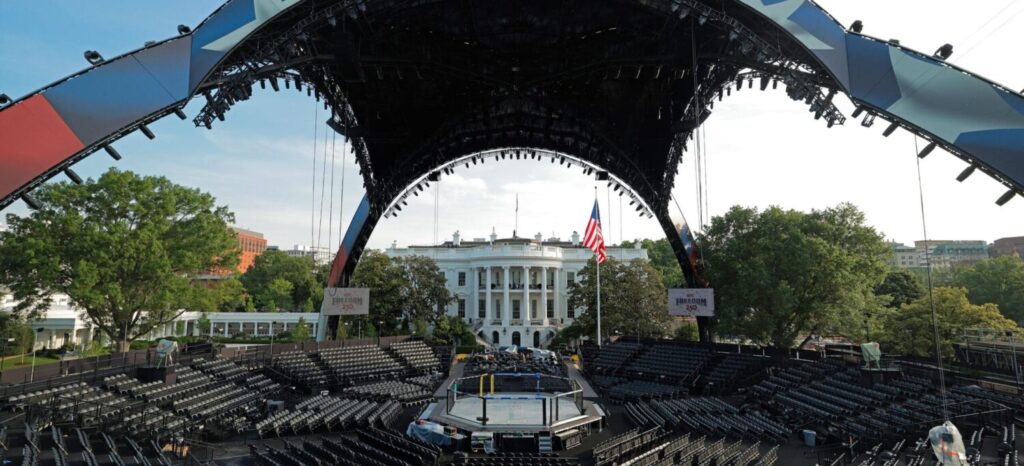
A retired activist and a Vietnam War veteran filed a federal lawsuit on June 6, 2026, asking a court to block "UFC Freedom 250," a cage-fighting event scheduled for June 14, 2026, on the White House South Lawn.
Chief Judge James E. Boasberg agreed. He found that the evidence of improper political motive was overwhelming, while the government's stated justifications were thin to the point of being pretextual. He quashed both subpoenas and ordered portions of the court record unsealed so the public could read about what happened.
Across five separate cases, the judge documented a troubling pattern: orders were issued, ignored, followed up on, and still ignored. People who had been ordered freed were flown across the country, held for days or weeks longer than lawful, and in at least one case released under conditions the court never authorized. The government attorney handling the cases frankly admitted to being undertrained, understaffed, and operating without a working email system. The judge took the matter under advisement.
This case asked whether the International Emergency Economic Powers Act, known as IEEPA, allows the President of the United States to impose tariffs on imported goods during a declared national emergency. The Court held that it does not.
The court made clear that historical facts, including uncomfortable ones, cannot be erased simply because current officials disagree with them.
For veterans considering public office or public commentary, this ruling provides reassurance that their service does not cost them their voice.
The central charge — Count 1 — accuses the defendants of violating Georgia’s Racketeer Influenced and Corrupt Organizations Act, commonly known as RICO. Prosecutors allege that the defendants formed a criminal enterprise and engaged in a pattern of unlawful acts designed to reverse Georgia’s certified election outcome.